

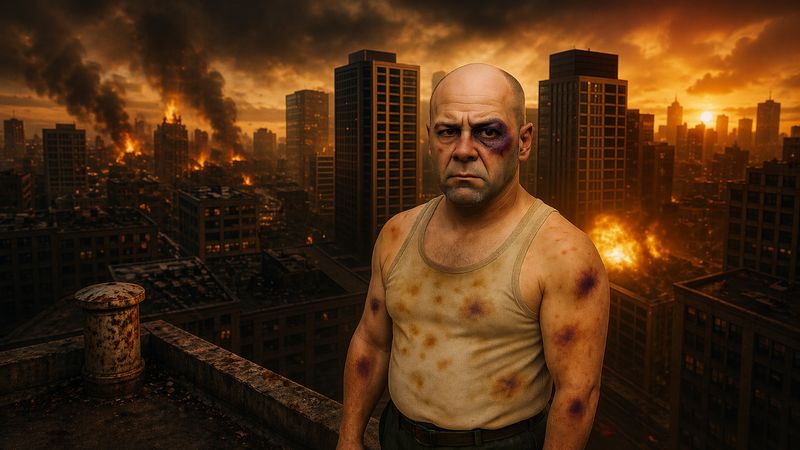
A Celebration Gone Bad
Bruise hadn’t come to the building for trouble. Trouble, as usual, had filed no paperwork and arrived uninvited.
The invitation in his pocket was printed on heavy card stock, the kind that suggested importance without specifying why. A “small, tasteful gathering,” it had promised—good music, decent company, and the kind of finger food that required confidence but no utensils. Bruise had agreed to attend for reasons that remained unclear even to him. Perhaps it was the promise of a sharp haircut voucher, or the rumor of exceptionally well-cut undershirts circulating among a very specific crowd.
He arrived late—not out of habit, but out of principle. The city felt tense that night, like it was holding its breath. Bruise didn’t blink. He adjusted his collar, noted the absence of his shoes with mild irritation, and stepped toward the entrance, prepared to endure small talk and questionable canapés.
Instead, he found locked doors, shattered glass, and a security guard who had clearly reconsidered his career choices. Voices echoed from inside—not laughter, but commands. The “tasteful gathering” had apparently evolved into a hostile takeover with a dress code problem.
Bruise sighed, as if inconvenienced by poor event planning. He slipped the invitation back into his pocket, glanced once at his bare feet, and pushed the door open.
Barefoot on cold concrete, he didn’t look like a man about to retake a building. He looked like a man who had misplaced his shoes and his patience in equal measure. The lobby lights flickered nervously, as if even electricity understood it was about to witness something unwise. Inside, more than twenty armed thugs had turned the place into a fortress of bad decisions. Bruise cracked his knuckles with the quiet confidence of someone who considered “overwhelming odds” a polite suggestion—and stepped in.
He entered without a plan—because plans require time, and Bruise preferred results. The first two villains rushed him, eager and profoundly mistaken. One met a doorframe at conversational speed; the other reconsidered his career path mid-flight.
Halfway through what could generously be called a discussion, a group of particularly bold henchmen decided to escalate matters in a different direction. Grabbing at him, they tore at his shirt with chaotic enthusiasm, shouting, “Are you Channing Tatum? Dance for us!” It was not their strongest strategic move. Buttons scattered across the floor like punctuation marks of regret, fabric gave way, and within seconds both his shirt and undershirt were reduced to historical artifacts.
What followed was less a fight and more a correction. Bruise moved like a man who had long ago stopped negotiating with physics. A chair became a brief argument, a table a philosophical statement, a fire extinguisher an emphatic rebuttal. Shoeless and now shirtless, he left a trail of consequences across every floor. Glass shattered, egos collapsed, and one particularly unlucky henchman learned that gravity, too, had a sense of humor.
The thugs tried numbers, then tactics, then pleading — none of which proved effective against a man who treated chaos like a home field advantage.
Minutes later, silence reclaimed the building. Bruise stood alone amid the aftermath, breathing steady, expression unchanged. Somewhere upstairs, a forgotten playlist resumed its cheerful indifference.
He glanced down at himself—bare feet, and shrugged. Stepping outside, somebody handed him a fresh undershirt.